
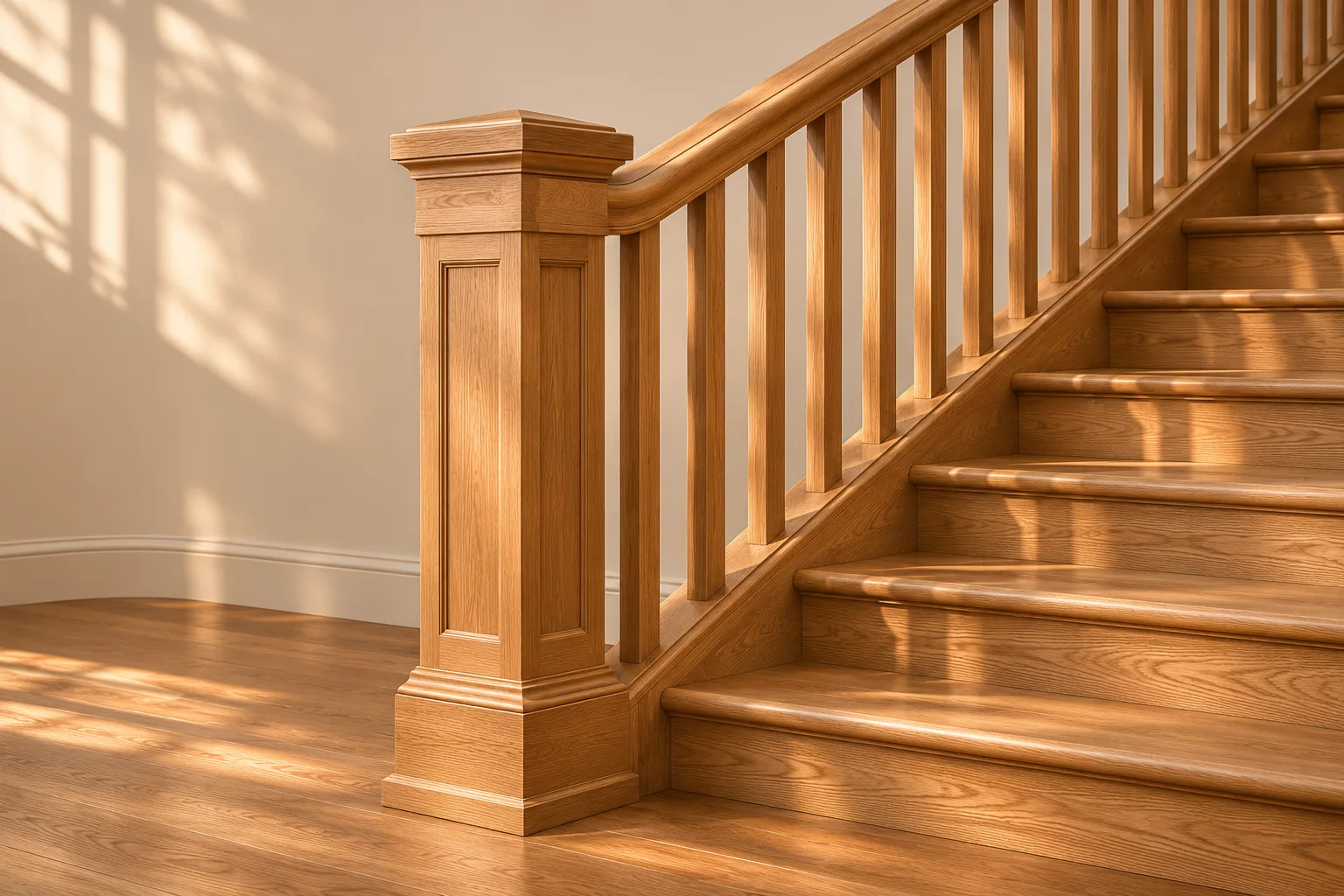
A custom stair project is worth exploring when it resolves a defined layout, condition or finish problem. Compare it with a suitable standard system, repair or cosmetic update before assuming custom work is automatically the right purchase.
What should the custom work achieve?
An unusual opening, a specific rail transition or a coordinated material package can be a reason to investigate made-to-fit parts. Identify that benefit clearly. Custom does not remove the limits set by the building, users, supports or applicable requirements.
Compare the alternative that leaves suitable parts in place. A smaller scope may meet the actual priority, while a structural or clearance problem may need more than a new appearance. The decision should follow the condition and intended result.
Ask what the professional package includes
Clarify survey, drawings, structural review where needed, approvals, demolition, supports, treads, rails, finishing, delivery and installation. Identify exclusions and who handles surrounding floors and walls. Paying for professional work is not, by itself, proof that every required review or inspection is included.
Cost is one trade-off, not the only one. Design dependencies, fabrication, temporary access, curing, maintenance and suitability for regular users all matter. Any resale benefit depends on the property and market; it is not a guaranteed recovery of the project price.
Consider professional custom work when it addresses a defined problem that a suitable standard system, repair or finish update cannot resolve. The points below are questions for that decision, not a recommendation that every property needs a custom staircase.
1. To Match Your Home or Commercial Space’s Unique Theme
Constructing a regular old staircase in a fancy home, hotel, restaurant, or any high-end establishment will stick out like a sore thumb. Don’t waste the aesthetic appeal of your interior design by not paying for professional custom-made stairs.
2. To Make Your Staircase Stand Out
Staircases have three purposes: functionality, utility, and vanity. They can get you to the next floor, serve as additional storage space, and grab the attention of your guests and visitors.
Unlike other parts of your home, a beautiful custom staircase can easily make all the difference when it comes to its appearance. Even a simple flare or spiral could become a good topic over dinner with friends.
3. To Accommodate Restrictive Design Plans
An unusually large opening may also benefit from a custom layout. Compare the available space and circulation with standard systems before deciding whether a bespoke assembly is needed; it is not automatically the only possible solution.
4. Weigh Resale Against Project Cost
A well-considered stair update may improve a property's appearance and buyer appeal. Any resale effect depends on the property, local market and project cost; it is not a guaranteed return or a ranked investment claim.
After all, stairs are like shoes; they reflect a home’s “personality.” Your staircase impression betters your home’s overall appeal to potential buyers.
5. Confirm Requirements and Responsible Parties
A custom staircase needs coordinated design, structure and installation responsibilities. Ask the proposed contractor how drawings, permits, inspections and site work will be handled, and have the intended layout assessed for the building's use.
Define the scope before commissioning work
Cost is one consideration alongside design feasibility, structural changes, access during work, fabrication dependencies, maintenance and suitability for the users. Compare a defined custom scope with appropriate alternatives rather than assuming every listed benefit follows from the purchase.
Historical photo reference from the original article: Xiang Hu. The current illustration is an architectural concept, not that original photograph.
Explain the problem custom work should solve, project city and alternatives being considered. Discuss a defined custom-stair scope before committing to the most extensive option.